























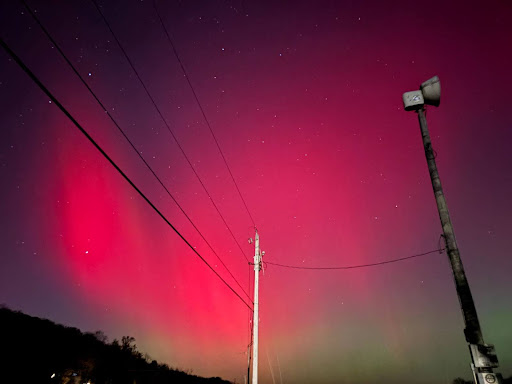
The Northern Lights, scientifically referred to as “aurora borealis,” were visible in 21 US states on Tuesday, Nov. 10. The beautiful display of lights is often an attraction bringing tourists to the Northern Hemisphere in places like Alaska or Northern Canada; however, within the past few years, the auroras have become more prevalent in the regions further south. Although beautiful, it could be a result of climate change.
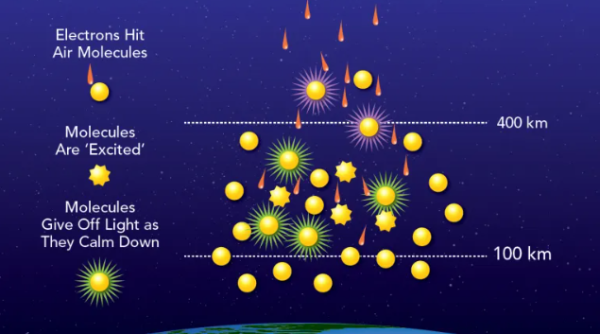
The aurora borealis is a natural phenomenon caused by the interaction of solar wind and Earth’s magnetic field. According to NASA, “The Sun continuously produces an outflow of charged particles into the solar system known as the solar wind. When the solar wind reaches Earth, it can interact with Earth’s magnetic shield, often depositing and accumulating energy there. When this energy is finally released, much of it rains down on our atmosphere, causing auroras.” (NASA). The colors of the aurora borealis are dependent on what gases they interact with, along with the altitude of the gas in the atmosphere. Oxygen results in greenish glows when at an altitude of 60-120 miles, while red occurs at 120+ miles. Nitrogen gas results in blue at 60-120 miles and deep reddish-purple colors when below 60 miles. (NASA).
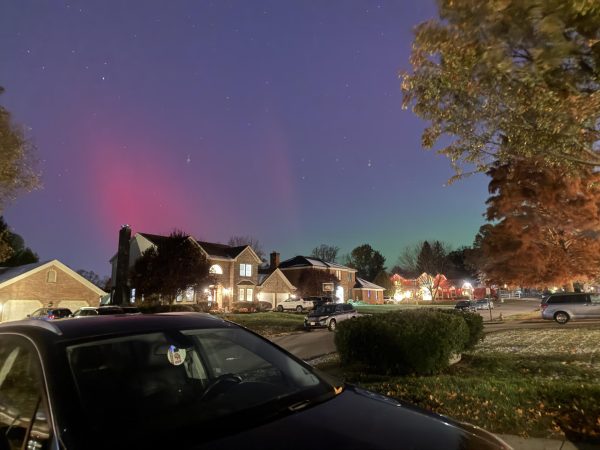
Since the colors and visibility of the aurora borealis are dependent on the state of the atmosphere, climate change could be impacting where they can be viewed and how brightly. As previously stated, the light show was visible in 21 US states, including Ohio. Many in South West Ohio were able to experience the display right in their front yard. This is astounding because previously, they were only visible in the Northern Hemisphere. So why are they now visible further south? According to Rashmitha Diwyanjalee, an environmental researcher from Sri Lanka, “Climate change can alter the geomagnetic field, potentially affecting the patterns and intensity of auroras.” (Climate Fact Checks). She also states, “As the climate warms, shifts in weather patterns may alter the best times and locations for observing the auroras. Regions traditionally known for aurora viewing might experience changes in visibility due to varying climatic conditions.” (Climate Fact Checks). These variables could be an explanation for why we are seeing them outside of the typical range.
Overall, the aurora borealis are not completely understood by scientists, and neither are the factors that play into their sudden shift in visibility; however, that doesn’t mean we can’t enjoy their beauty. Fortunately, the next display is predicted to come back sometime between now and February 2026.