


















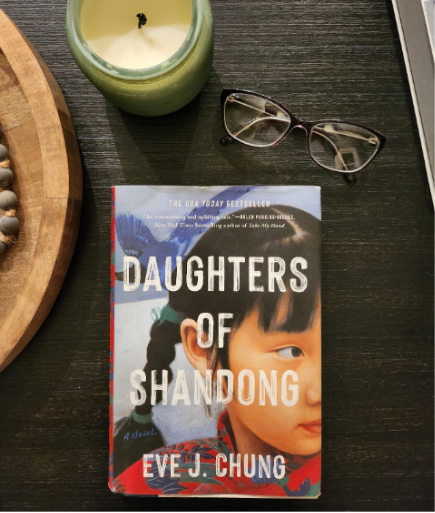
The “Daughters of Shandong“ opens to a country covered by hardship and uncertainty. Eve J. Chung’s novel blends historical detail with personal storytelling, placing readers into war-ridden China in an immersive way. It’s a powerful story that holds raw emotion, haunting truths, and unforgettable details, which makes it a meaningful work of historical fiction.
Set against a landscape trembling from political uprising, the story builds its foundation on tension and transformation. The story centers on Li-Hai (often called Hai), the eldest of her siblings, who grows up in a time when girls are undervalued and constantly limited by strict expectations. As the country of China becomes more unstable, Hai is put into situations that challenge her understanding of family, values, and her own strength.
Chung’s descriptive and powerful words make readers feel like they’re placed in the storyline along with the characters. Part of the book’s beauty comes from the emotional historical fiction that speaks across generations. The story shines light on women’s stories often hidden by history, and gives a voice to those who lived through eras of strict tradition and relentless expectation. Chung’s details elevate the story, making the setting feel less like a background but more like a living environment, affecting every choice the characters make.
Character development is one of the book’s strongest qualities, and Chung makes it a beautiful thing to read. The sisters show a range of emotions: hope, spite, defiance, and grief. Their actions, thoughts, and decisions are purely human. Their relationships are built in love, but complicated by pressure and trauma. Chung doesn’t rely on dramatic words or scenes. Instead, she writes with what can only be described as a quiet intensity that makes the emotional moments more impactful.
The pacing also contributes to the story’s strength. Each chapter flows with a steady rhythm, making readers want to continue turning the pages over and over again. Chapters hold smaller stories tucked inside the main story of memories, traditions, and beliefs.
Still, even amazing books can carry tiny imperfections. While the main characters are really well developed, some side characters feel less explored, and their time in the book comes to an end before the impact of their presence is fully shown. This isn’t a major flaw, but I found that keeping track of the side characters can be confusing, especially when they are mentioned again later on in the book.
While the beginning of the story is filled with uncertainty, fear, and grief, the ending shows how far Hai and her family have come. The ending fulfills a sense of hope and personal triumph. It brings the journey full circle without losing the emotional weight of everything she and her family endured. And yes, I cried a little at the end. Though, of course, they weren’t sad tears but “wow, that was an amazing story” kind of tears (if you do decide to pick up this book, I encourage you to read the author’s note at the end). “Daughters of Shandong” is a worthy read and well worth any price a store labels it as. Readers who appreciate gripping, historical fiction driven by emotion will not regret reading this powerful story. “Daughters of Shandong” deserves an ‘A’ for its fierce storytelling and unforgettable impact.