




















What do you think of when you hear the term tuberculosis? If you’re familiar with world history, you might recognize it as a devastating disease, but a disease of the past, nonetheless… or so one would think. Although the United States is one of the countries that’s wealthy enough to provide adequate healthcare and vaccinations, developing countries, such as Sierra Leone in sub-Saharan Africa, still suffer from the tuberculosis epidemic.
Now, what comes to mind when you hear the name John Green? While many students recognize him as the host of the popular educational channel Crash Course, John Green is also a New York Times Bestselling author who has written novels such as The Fault in our Stars and Looking for Alaska. Despite his background in educational videos, when I saw that he was publishing a non-fiction book, I was surprised and intrigued.
However, Everything is Tuberculosis isn’t Green’s only experience with the non-fiction genre. Green’s first non-fiction book, The Anthropocene Reviewed, is praised by Goodreads as a charming collection of essays that explain the impact of human activity on our planet. Although the book was published in 2021, The Anthropocene began as a podcast hosted by none other than Green himself, starting in 2018.
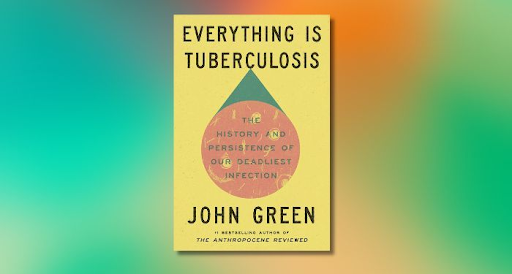
Originally published in March of this year, Everything is Tuberculosis proves itself to be a thought-provoking, informational work. As readers have their eyes opened by Green’s fantastic writing, this book will reveal just how deep the roots of the tuberculosis epidemic have entwined themselves in our society.
To open the novel, we’re introduced to Henry, a young boy from Sierra Leone infected with tuberculosis whom Green met while traveling throughout West Africa. Green describes their first impressions of eachother at the hospital he visited, and how the boy’s kindness left an impact on him that inspired him to pursue tuberculosis research once back in the States. The rich storytelling in the first chapter gives a great introduction to Green’s research, and ensures the audience becomes as invested in Henry’s future as he became.
Throughout the novel, Green provides a chronological sequence of the history of tuberculosis, all while relating these historical events to Henry’s experience. These striking parallels emphasize that despite advancements in tuberculosis treatments, children like Henry continue to suffer as patients did in the nineteenth and twentieth centuries. Although Henry’s story is our main focus, Green includes the stories of other villagers and former tuberculosis patients of the past century in each chapter. The personal accounts of these survivors’ experiences enlightens the reader to the stigmatized treatment of tuberculosis patients in their communities, populous environments, and the sanatoriums where they were treated. These firsthand accounts garner more sympathy than mere statistics ever could.
Authors must be careful when writing about topics such as eugenics and imperialism, as is frequently relevant in the history of tuberculosis. Nonetheless, when referencing a ridiculous beauty standard of the Gilded Age or critiquing a “scientific advancement” of the past, Green’s wit and humor is perfectly translated from the thumbnails of his Crash Course channel.
Although Green writes passionately about the way the disease has been woven into our society, he doesn’t offer many resolutions to the issues that people in developing countries face. Instead, there were points in the novel where I felt overwhelmed by the flood of depressing statistics without solutions being implemented. However, Green’s informative, yet blunt tone emphasizes the absurdity of this expansive epidemic compared to the funding it receives. It’s clear that extensive research, care, and thought was put into the novel through Green’s narration of his journey with Henry.
Even if you don’t consider yourself a reader, or struggle with engagement, Green’s writing style captures the reader’s attention to a topic deserving of our consideration. Through its didactic yet witty writing, Green’s second nonfiction novel is absolutely deserving of the praise it initially received. I would highly recommend this book for curious readers and anyone interested in healthcare or history, and assign it 5 out of 5 stars!