
























Testing accommodations are given to students with learning disabilities such as ADHD, visual impairment, autism, and many other reasons. These testing accommodations are given to help students with learning disabilities to finish tests, but even students who don’t have learning disabilities don’t always finish tests. That’s why all students should have access to extended time on tests.
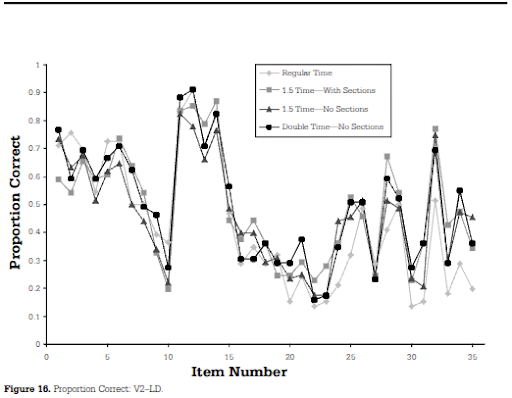 Studies have shown that extended time on tests can benefit not only students with learning disabilities but also students who don’t have them. According to the graphs in The Impact of Extended Time on the SAT Test Performance. Students with access to extended time performed better than those who did not have extended time. In a graph comparing students with extended time vs those without, the group that had extended time had more correct answers than the group that didn’t have extended time. Weaver S. M., a scientist who studied at the University of Toronto, said “Students without disabilities … improved in the extended-time or untimed conditions on the comprehension test”. In the ACT reading section, students have 35 minutes to answer 40 questions. If a student had extended time, ACT scores could increase based on Weaver’s research.
According to Revolutionizing Learning Disability Identification Through Process Data Analysis, 40% of students have an undiagnosed learning disability. That means that a little less than half the students taking tests in schools are not getting the accommodations they need to thrive in school. According to What We are Learning from NAEP Data About Use of Extended Time Accommodations it says that “Students who were given extra time, regardless of whether they used it, reported feeling less time pressure, higher math interest, and enjoying math more.” Giving extended time to students who might not need it could help relieve the test anxiety many students have, especially since 40% of students have an undiagnosed learning disability.
Lily Stewart, a student at Oak Hills High School, who recently got extended time accommodations in her senior year of high school, says that before, on tests, she felt like she didn’t “have as much time”. Spent almost her entire time in school struggling through tests. Stewart said that with bigger tests, she didn’t finish any test she had ever taken. For many students, it can take a long time to be diagnosed with a learning disability and then get extended time accommodations. Lily says that to get her extended time, she had to talk with a handful of school psychologists and doctors. If every student had testing accommodations, then students wouldn’t have to jump through hoops to get the help they need.
Some people may believe that most students that don’t have extended time on tests can finish so that means that they shouldn’t have access to extended time if they don’t have a learning disability but just because most students can finish a test doesn’t mean that is all students and according to the Every Student Succeeds Act, it believes that every student should have an equal opportunity to thrive.
All students should have access to extended time because students should be tested on what they know, not on how fast they know it. Extended time could help make tests way less challenging and stressful for students. So if you or your student has a problem, talk with a counselor to help you or your student thrive in school.