












8,300 offers and $80 million.
That’s how many offers the College Sports Commission (CSC) has cleared for Name, Image, and Likeness (NIL) deals for college athletes since early September of 2025, according to ESPN. The CSC is in charge of regulating and approving NIL offers greater than $600, attempting to limit the explosion of NIL for college athletes.
The total worth of NIL deals for the 2024-2025 year is estimated at $1.67 billion, far exceeding the $917 million market share of the previous year, according to a report from Athletic Business. But what exactly is NIL, and why is it a problem?
NIL, which stands for Name, Image, and Likeness, is where an athlete is used for marketing purposes, like partnering with companies, using their name, or using their influence on social media. While this is beneficial for athletes economically, the focus of college sports is overshadowed by the desire to be marketed and to profit from sports.
While this motivates students to pursue their athletic dreams, sports are now prioritized over education, a large issue in High School and Collegiate Universities. The students also face the consequences of money without the knowledge of dealing with it. Some students, however, come at it with a very unusual approach, such as Quincy Wilson.
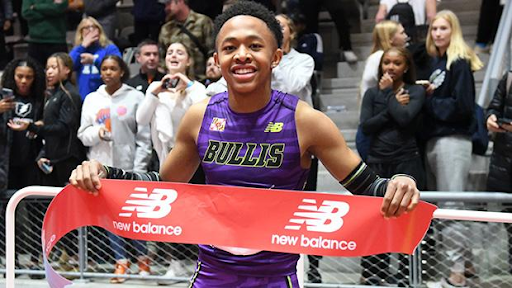
Wilson, now a Junior at Bullis High School in Maryland, is famous for setting the Under-18 record in the 400m dash in a staggering 44.1 seconds and being a young Olympian who contributed to the men’s 4x400m relay on the world stage. When asked about NIL, Wilson simply said, “For me, academics always come first.”
Making his academic focus prioritized, he adds, “It’s the last season for a lot of the seniors that I came into Bullis with. It’s our last time to make memories and run 4x400s together. Last year, we fell short of some of the things that we had our goals set on.”
While each NIL deal is personal to each athlete, there must be a limit to the extent of the deals being made. While Wilson’s exact worth in NIL is unknown, other stars have numbers to their names, such as Texas quarterback Arch Manning at $1.6 million and Bronny James at a whopping $5.1 million.
With these two college athletes, it is clear that performing in college and professionally can be the main focus over academics. But other claims arise. If it’s what they want to do, why can’t they do it?
The simple answer? They can and they should. Just not yet.
Tyler Shough, a former Texas Tech quarterback, explained that with NIL deals, he feels athletes can “be recognized as people and not just athletes in a jersey,” and that “We really do have a lot more to offer.”
With all the different sides and opinions on NIL deals, the NFHS (National Federation of State High School Associations) aims to keep education the primary focus. 36 out of 50 states do not allow “a student-athlete to profit from their NIL while wearing the school uniform or connected to the school in any fashion”.
High School education should be prioritized for High School students, especially athletes who face burnout, injury, and may end up quitting the sport because they aren’t good enough. This regulation by the NFHS helps High Schoolers in the 36 states included, but it should be expanded to a national level. Do we trust High Schoolers making millions, experiencing pressure from media, fans, and themselves to truly follow the path they want?
While NIL is good for the individual athlete, the surplus from which it is coming is astounding. A limit must be set on them, or High School sports will have no difference from professional sports.