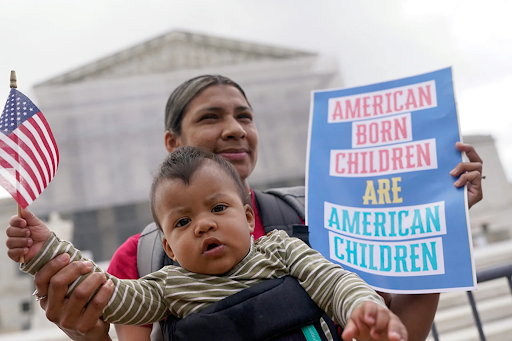
The debate over birthright citizenship (the idea that citizenship is granted to any individual born in that nation, regardless of the parents’ immigration status), is popular in the government right now. Many believe it’s considered a human right written in the Constitution, while others disagree and claim it does not apply to today’s immigration.
This right is guaranteed in the US by the 14th Amendment of the US Constitution, which states, “All persons born or naturalized in the United States and subject to the jurisdiction thereof are citizens of the United States and of the state wherein they reside.”
Originally, this amendment was created to give former slaves citizenship. It overruled the Supreme Court decision Dred Scott v. Sanford which held slaves are property, not citizens.
Jan 20, 2025, President Donald Trump signed an executive order (EO) 14160 to end birthright citizenship.
In this EO, President Trump restated the 14th Amendment citizenship clause and claimed, “This provision rightly repudiated the Supreme Court of the United States shameful decision in Dred Scott v Sanford, which misinterpreted the Constitution as permanently excluding people of African descent from eligibility for United States citizenship solely based on their race. But the Fourteenth Amendment has never been interpreted to extend citizenship universally to everyone born within the United States.”
This would deny citizenship to individuals born to a mother who is unlawfully or not permanently residing in the United States and a father who is not a US citizen or a lawful permanent resident at the time of the birth. The order, specifically orders federal agencies not to recognize the citizenship of children born after February 20th, 2025 if their parents fall under that category.
Senior U.S District Judge John Coughenour of Seattle was the first federal judge to weigh on the practicality and legality of the executive order; he called it “blatantly unconstitutional”. Other judges followed and blocked the Executive order from going into effect.
In March of 2025, Trump and his administration were prompted to go to the Supreme Court, asking the judges to weigh in on the authority of nationwide injunctions (orders by federal district judges that prohibit the government from implementing that policy in the US). Viewing these injunctions as judicial overreach.
This resulted in the Supreme Court case Trump v. CASA, which limited the lower courts’ power to issue universal injunctions. Claiming they “likely exceed the equitable authority that Congress has given to federal courts.”
So why is this being talked about a year later?
April 1st, 2026, another Supreme Court case, Trump v. Barbra, regarding the legality of the EO, occurred orally in court.
It is also important to note that the birthright citizenship clause application was upheld in the Supreme Court case Wong Kim Ark v. US, 1898. Wong was born in the US with immigrant parents. After returning from a trip to China, he ran into issues with immigration. The court ruled in his favor, and Justice Horace Gray claimed that although the 14th Amendment’s main purpose was to establish citizenship for African Americans, the amendment is still applicable to people of different races and ethnicities.
U.S. Solicitor General D. John Sauer represented the Trump administration. He told the judges the president’s reasoning behind the EO. Restating the 14th Amendment was originally intended to give citizenship to freed slaves and the children of said freed slaves.
He also argued that most countries do not have birthright citizenship, which he believes “rewards” illegal immigration.
Additionally, he spoke about “birth tourism”, which is the practice of women coming to the US to give birth so their children have citizenship. Which he claims “Will create a whole generation of American citizens abroad with no meaningful ties to the US.” Chief Justice Roberts challenged Sauer’s claim on birth tourism as the two went back and forth.“We’re in a new world now.” Sauer responded. Roberts ended the conversation, “Well, it’s a new world. It’s the same Constitution.”
The lawyer who represented the challengers, Cecilla Wang spent much of her career defending immigrants’ rights in America argued that “everyone born here is a citizen” is a long-established agreement that the United States has made.
She claimed the 14th Amendment established a “fixed bright-line”, and the citizenship clause is “workable”. She also said the Trump administration’s interpretation would upend the Constitution and the lives of millions of people.
Wang states,“Swaths of American laws would be rendered senseless. Thousands of American babies will immediately lose their citizenship. And if you credit the government’s theory, the citizenship of millions of Americans, past, present and future, could be called into question. All of this tells us the government’s theory is wrong.”
Regardless, the question presented to the court is whether the citizenship of children born to unlawfully or temporarily residing parents is consistent with the birthright citizenship clause in the 14th Amendment.
The case is still ongoing, but many sources believe the Supreme Court will rule in favor of the Trump administration. This decision is expected to end by late June or early July.