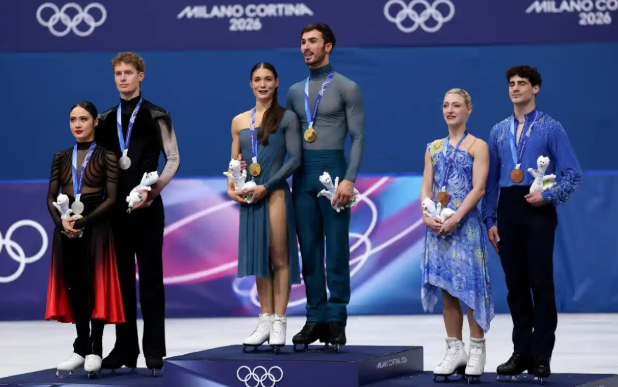
Judging in Olympic figure skating has faced controversy many times, but recent controversy has started calls for reform. At the center of the debate is whether judges should be permitted to score athletes from their own countries. National affiliation creates a perception of bias, which undermines true results in the world’s biggest competition.
The issue resurfaced during the 2026 Olympic Winter Games when American ice dancers Madison Chock and Evan Bates delivered a technically excellent free dance in the ice dance final. Despite completing their routine without visible errors, they were placed behind the French team, who won gold even after making noticeable mistakes in their free skate program. The result ignited debate among fans and commentators about scoring consistency and national bias.
According to reporting by BBC News, a world-leading public service broadcaster, questions arose about the judging panel and whether national ties influenced scoring components such as performance and interpretation, which are both areas that involve subjective evaluation. At the same time, The Athletic, a news organization that provides sports stories and analyses, explained how scoring margins in program components, rather than technical elements, made the French team’s victory decisive. Those categories allow judges greater discretion, increasing concerns about subconscious bias.
The controversy deepened when Newsweek reported that a French skater later acknowledged an error in the medal-winning routine, fueling arguments that the American pair’s clean skate should have won. The French figure skater, Guillaume Cizeron, explained that the pair “made a few mistakes” and that they “know it,” but they have to do “everything they can not to show it and keep performing.” Newsweek is a global media company committed to fair and independent journalism. Critics agreed that even the appearance of this controversy damages the credibility of the Olympic competition.
Research supports those concerns. A study published in the Journal of Sport & Exercise Psychology found evidence of national bias in judged sports, concluding that judges tend to award higher scores to athletes from their own countries. The study’s authors, scholars in sport psychology and performance evaluation, noted that such patterns are often subconscious but statistically significant. In events decided by fractions of a point, even small biases can alter podium placements.
The International Skating Union, the sport’s governing body, currently allows judges from participating countries to score events, though they are required to follow a code of ethics and anonymity protocols. However, some argue that ethical guidelines do not eliminate bias. When a judge from France evaluates a French skater, or a judge from the United States scores an American athlete, questions naturally arise, especially when outcomes are disputable.
Reforming the system to prevent judges from scoring athletes representing their own countries would not be a bad idea. Other judged sports have adopted regulations to reduce conflicts of interest, including rotating panels or excluding certain judges from specific games. In figure skating, a similar rule could help restore confidence without destroying the existing scoring framework.
Supporters of the current system argue that national representation on judging panels ensures global expertise and fairness. Judges are trained professionals capable of separating personal affiliation from subjective evaluation.
Even so, perception matters as much as reality in Olympic sports. Even if judges act with complete integrity, the appearance of favoritism diminishes trust among athletes and spectators. In the Chock and Bates case, the debate extended beyond technical analysis to bigger questions about transparency and accountability. When clean performances do not align with final placements, skepticism grows.
The Olympics represent the height of international competition, where medals can define careers and legacies. To protect this idea, governing bodies should prioritize fairness. Preventing judges from scoring athletes of their own country would be a measured reform aimed at strengthening credibility. In a sport where artistry meets razor-thin margins, confidence in fairness is as essential as the blades on the ice.