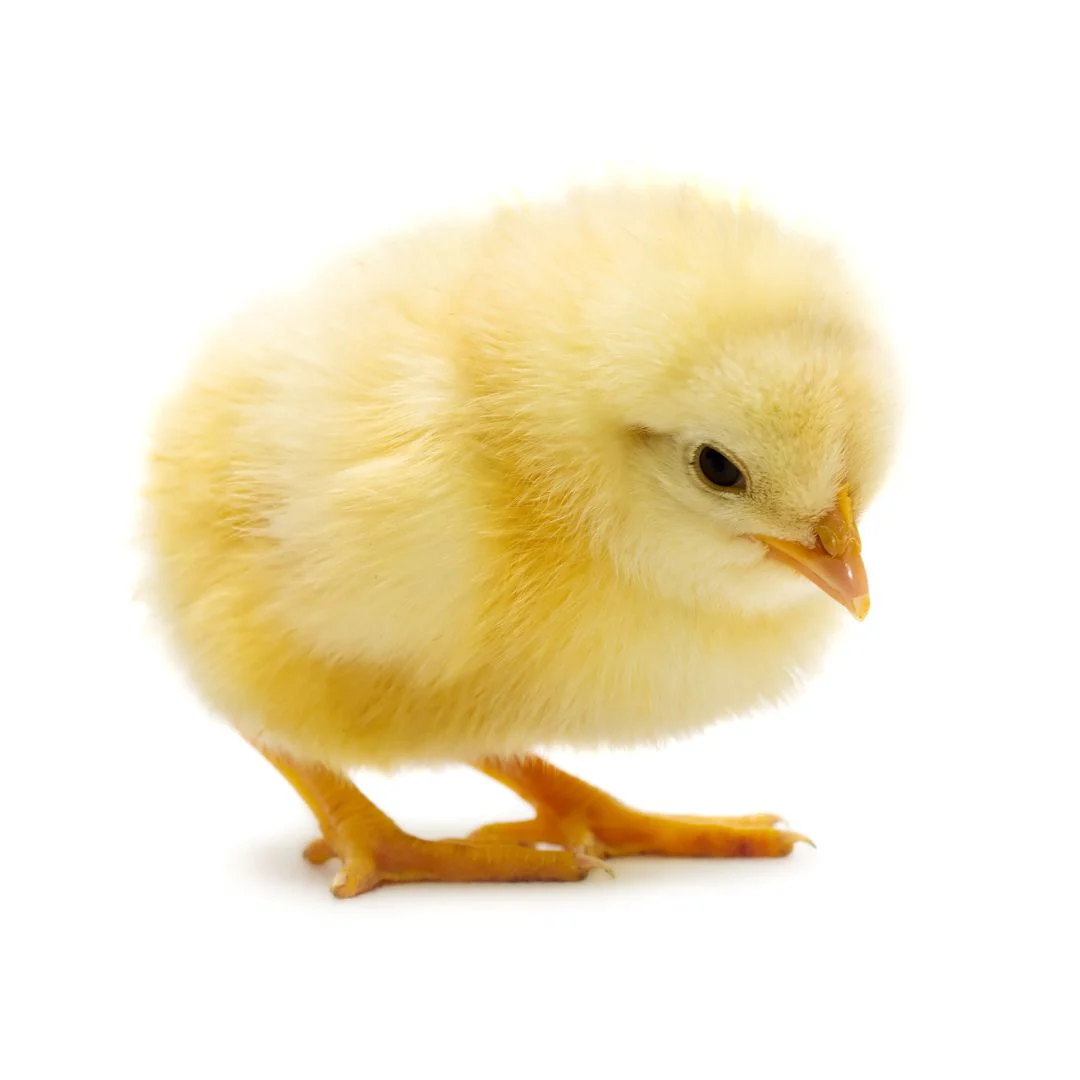
Have you ever wondered how smart baby chicks are? Well researchers Maria Loconsole, Silvia Benavides-Varela, and Lucia Regolin at the University of Padova in Italy did and their discovery is both fascinating and adorable. Using what is known as the “Bouba/Kiki effect” these researchers discovered that baby chicks associate sounds and shapes similarly to humans.
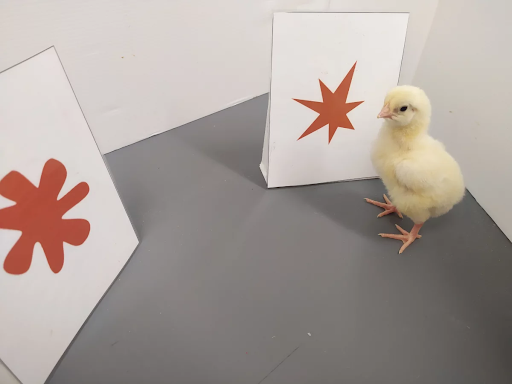
In 1929, psychologist Wolfgang Köhler, demonstrated sound symbolism with what has now been coined the “Bouba/Kiki effect.” The effect refers to a study where participants are presented with two shapes. One with round edges and the other with sharp edges. Participants are asked to assign the names Kiki and Bouba to each shape. Various studies show that on average, 88% of people are in agreement that the shape with round edges is “Bouba” and the shape with sharp edges is “Kiki.” Using this study, the researchers were able to test if baby chicks formulate connections between sound and shape similarly to humans, and shockingly enough, they do!
Maria Loconsole says “With chicks, we had the chance to test animals at the very, very first stage of life,” The study being conducted on such young chicks was to see if naturally, without any other influence, chicks were born with the ability to make these connections. She went on to explain that they introduced the chicks to a panel with a shape that was both round and spiky then taught them that they would receive food by going behind the panel. Then, they introduce the two shapes, one round and the other spiky. This left the chicks with “uncertainty” but when they played a sound saying either “Kiki” or “Bouba,” the chicks would choose a panel to go behind. Researchers found that when the “Bouba” sound was played, the chicks chose the panel with the round edge shape, and when the “Kiki” sound was played, they chose the panel with the sharp edge shape.
While the study doesn’t prove that chicks understand human language, it does show that chicks can make connections between shapes and sound, and not just that they make the connections but that they do it similarly to humans. This study could be the beginning of research into the creative capacity of other vertebrates. Not to mention, it is incredibly adorable that humans and baby chicks might not be so different after all.
Work Cited:
Greenfieldboyce, N. (2026, February 19). Baby chicks link certain sounds with shapes, just like humans do. NPR. https://www.npr.org/2026/02/19/nx-s1-5717039/baby-chicks-link-certain-sounds-with-shapes-just-like-humans-do
Marian, V. (2023, April 3). It’s a Bouba, Not a Kiki: The Relationship Between Sound, Form, and Meaning. Behavioral Scientist. https://behavioralscientist.org/its-a-bouba-not-a-kiki-the-relationship-between-sound-form-and-meaning/
Perlman, M., & Winter, B. (2026). In search of meaning. Science, 391(6787), 762–763. https://doi.org/10.1126/science.aee8641