
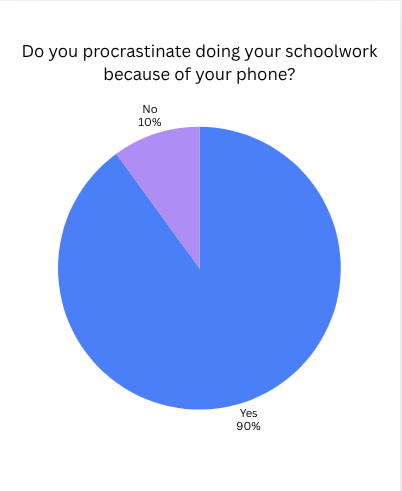
 Students in high school often fall under academic pressure, which can severely affect their mental health and quality of life. But what really accelerates these negative effects is procrastinating. In a poll of 50 Oak Hills students across all grades, 90% said they procrastinate doing their schoolwork because of their phones. The National Library of Medicine reported that, “Procrastination was associated with greater social jetlag, shorter sleep duration, and worse sleep quality” (Li & Buxton). This shows that high school students who procrastinate because of their phones experience lower academic and athletic performance.
Procrastinating can cause detrimental harm to students’ academic performance due to a lack of sleep and distractions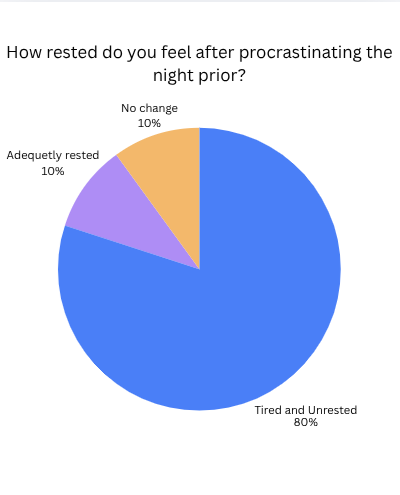 from their phones. Oak Hills High School students reported on a poll of 50 students that 80% get less sleep or feel unrested after choosing to be on their phone instead of doing their homework. This can lead to a lower academic performance because it is proven that well-rested students perform better in school, according to Northfield Hospital + Clinics. Phones have became apart of almost every aspect of life, students should use them as tools, not to distract them from excelling in their academics.
Procrastinating can also hurt athletics because the same habits that delay schoolwork often reduce the time and energy athletes need for training, recovery, and preparation. When students stay up late on their phones instead of finishing homework or going to sleep on time, they are more likely to feel tired 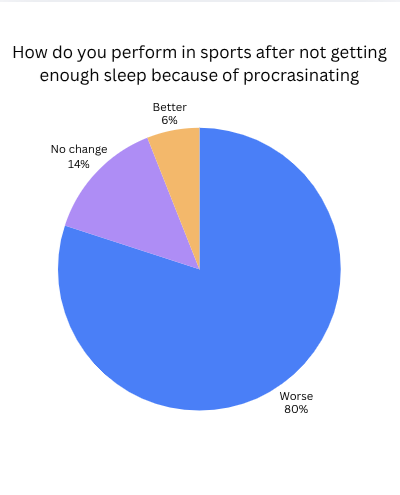 and less motivated during practices and games. In a poll of 50 Oak Hills athletes, 80% of them reported that they perform worse if they don’t get enough sleep or procrastinate the night prior. That lack of rest can weaken endurance and make it harder to perform at a high level. In sports, success depends on consistency and discipline, so students who procrastinate may find it harder to balance academics with athletics and may not reach their full potential.
To conclude, procrastination because of screen time can lead to lower academic and athletic performance in Oak Hills students. To increase performance and decrease procrastination, students could set screen limits on apps that distract them, prioritize doing homework at school, or have an allotted time each day for uninterrupted schoolwork without their phone in the room. The Child Mind Institute reports that, “Research indicates that the mere presence of a smartphone reduces cognitive capacity, breaks concentration, and leads to poorer test scores, even if the student is not actively using it.” Reducing procrastination cannot only lead to better short-term effects like better grades and sleep, but it can also positively affect a student’s ability to perform tasks efficiently and focus on their goals for their future.