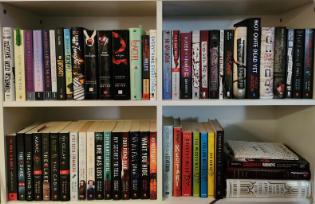
Sitting in a cozy chair, wrapped in a warm blanket, is so much better with a book to read. The smooth pages brushing against your fingers feel better than the glossy screen of an online book. Reading a physical copy of a book increases comprehension and doesn’t strain your eyes. eBooks also allow distractions like social media to interrupt your reading time. Holding a print book is better than grasping at the thin screen of an eBook.
The quiet atmosphere of a bookstore is one of the many perks of shopping for books. Walking inside, the environment is welcoming and warm. People flow around, wandering from fiction to romance in the hunt for a new book. This environment is something people who read online miss out on. In a “survey conducted by the Pew Research Center, 32% of Americans claim they only read print books,” Rob Errera, an award-winning journalist, wrote in his article Printed Books vs. eBooks Statistics, Trends and Facts [2024] that only “9% said they only read ebooks.” eBooks may seem like they are rising in popularity, but many Americans are still sticking to physical books as their preferred book form. While eBooks are still popular among readers across the world, physical books still take the lead.
Print copies of books can increase comprehension and further allow readers to take in the words of the author. Reading the words from a soft page is significantly different from staring at a white, pixelated screen. Heather Rose Artushin, an author for Psychology Today and a Circle of Security Parenting Facilitator, stated that “research suggests that comprehension is six to eight times better with physical books than e-readers.” It’s easier to retain information when the information is read on paper rather than through millions of pixels. Our brains are not made to multitask. Scrolling through the pages on a screen causes your brain to have to focus on scrolling and reading at the same time, which has been proven to interrupt deep comprehension.
Staring at a screen for hours at a time can cause a strain on the eyes. According to Reid Health, a non-profit healthcare system, adults spent an average of 11 hours a day looking at a screen. Since COVID, the number has jumped to 19 hours a day. It’s important to give your eyes a break, and picking up a print copy of a book can do just that. “Computer Vision Syndrome, or digital eye strain, refers to issues that affect your eyes,” Cleveland Clinic wrote in its article Computer Vision Syndrome (Digital Eye Strain): What It Is. Electronic screens are filled with pixels that allow the text to be seen. Scrolling on the screens causes your eyes to constantly have to focus and refocus on those tiny pixels, which can lead to strain in your eyes.
Reading online opens the world of social media access. While reading an e-Book, a TikTok or Snapchat notification might pop up across the top of the screen, momentarily disrupting the reading flow. “Psychological research long ago proved what most of us know from experience: frequent interruptions scatter our thoughts, weaken our memory, and make us tense and anxious,” Wylie Communications, a training and consulting firm that helps others improve their writing, pulled from Nicholas Carr’s book, The Shallows: What the Internet is Doing to Our Brains. “‘The more complex the train of thought we’re involved in, the greater the impairment the distractions cause.’” As people continue to read on their phones, laptops, and tablets, their chances of getting distracted increase. Remembering the storyline of a book can become more difficult as the brain gets interrupted during the process of reading.
Some people might argue that reading online allows them to have more access to books, and while that is true, electronic devices eventually run low on battery. It could be inconvenient to have to find an outlet and/or charger and sit and wait for the device to either reach a stable charging point or turn back on again.
It’s better to read a print book as it helps comprehension, there are minimal distractions, and it won’t cause strain on the eyes. Pick up a physical book and find somewhere comfortable to read. There is a difference between reading the print on a physical book and squinting your eyes to read the pixelated print on an electronic device. The difference could change the way you read for the better.